 |
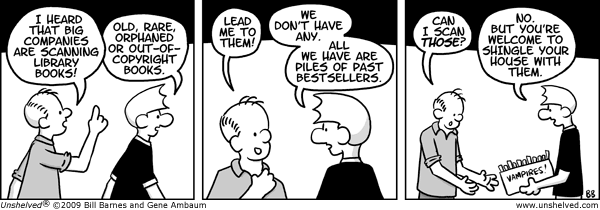
| Unshelved comic for 9/9/2009 www.unshelved.com |
One of the rallying cries of people who want copyright reform and pirates alike is "Information wants to be free!". One of the wonderful things about libraries is that information is (mostly) free - although there is still an impressive amount of copyright violation going on in public libraries.
First, it's important to note that the main idea of librarianship is legal. The American Library Association (ALA) states that under the "first sale" doctorine, the lending out copyrighted materials is protected by law. Any materials that are no longer protected by copyright (such as Hamlet, but not a Translation of The Inferno, because the translation is still copywrited) or published under a Creative Commons license doens't have those concerns.
However, books aren't the main pirated material in the library. Unsuprisingly, that would be music. As an employee of the Fargo Public Library, I have seen people come in, rip our CDs without checking them out, and then put them back on the shelves.
This is definately not a strictly a Fargo phenomenon. In a blog entry from The Library Journal, which references a since-removed Chicago Tribune article and poll, finds that this is widespread among the patrons from Chicago's public Library system. The article points out that although it is copyright violation, most of the people who responded to the poll believed it fell under fair use. Borrowing a CD and ripping it, or taping a song of the radio are similarly illegal, but all of these methods are looked over, since it isn't the major music lables don't see that as a major threat to sales.
Another form of copyright infringement that happens frequently is the use of photocopiers in the library. Most libraries (both public and academic) provide photocopiers to their patrons, and for 10 cents, any item may be copied . Most often, at least at the Fargo Public Library, it's specific articles from newspapers being copied. This is generally looked over by the copyright holders (The Fargo Forum, in this case) because it is such a small scale copyright infringement.
All of these copyright violations aren't attacted, possibly because the Internet is not involved. Any attempt at internet copyright infringement - downloading or viewing anything illegal on a library computer or wireless network- is strictly forbidden by the libraries policies, and doing that would get you banned from using the computers.
It's interesting to see how libraries can be seen as a haven of copyright infringement, and how libraries can and do avoid that label, and continue to provide free information for their patrons.

