Friday, April 29, 2011

The Auster Defense

Moving Library Books. Taken from the Exeter University library Flickr Stream

Paul Auster, in the first book of his New York Trilogy, created an interesting argument about the use of words. To paraphrase his argument: if an object no longer serves it's purpose, it really cannot be called by it's proper name anymore.

So, according to Auster, a library with no books cannot be called a library. What makes Auster's argument interesting is that is has something to with current news in academia.  According to the news website Inside Higher Ed, the Penrose Library at the University of Denver is planning to perminantly move 80 percent of their books off campus. 

The Article goes on to state that the library's focus is to focus more on becoming a social and study space for students, and that most of the texts leaving the library are journals (which are mostly accessed digitally), government documents, and less-used books, citing a national trend for an increase in library social space.

The librarians arguing for the storage of those materials do have some valid points. As an English major - a degree that requires lots of research from journals and books - I've relied heavily on electronic journal articles, mostly due to the convenience and ease of access (one can simply search for relevant articles rather than having to slog through mountains of possibly relevant journals)

Also, I have never needed to find government documents. I know that having documents available is important for transparency, but I've never known anyone to read those documents (at the Fargo Public Library also has a similar setup, but I think for a public library, it's more important to the people at large to have access to those documents)

However, the part about unused books has me concerned. Although all of the books don't get checked out of a library, it's still important to have them available for students, especially those that are out of print, but not yet in the public domain, or outside of the price range or scope of the students or other libraries - musical scores for example, are kept at the NDSU library, and the cost of a symphonic score can be outrageous, depending on the piece)

Also, to tie in this argument to Auster's, can a library keep its name without the books? There are lots of meeting spaces on campus - computer labs and common areas aren't rare, and the availability of study material must be kept in mind along with the availability of study space.

There may be a point where academic libraries can digitize their entire collections, and facilitate more meeting space for students. However, we have not reached that time just yet.

Sunday, April 24, 2011

Virtual Light/Virtual Heat

from mondolithic.com


Any book ever published in the history of, well, history, free for anybody to read, and curated online by people who specialize in getting information out to the masses. This subject sounds a bit Utopian, as well as something out of a William Gibson novel. However, the reality is that this had almost arrived, and that there's a good chance that it might still happen.

Initially, Google had planned to make an online library and bookstore, after digitalizing massive amounts of books.  This was struck down by a New York federal judge, out of concerns for copyright and Google's monopoly on the market (if successful, Google would have been the only people who have access to much of their content, and they could profit from it without the consent of the copyright owners)

However, out of the defeat of one idea comes the birth of the improvement on that idea.  After Google was blocked from completing their digital library, a movement has risen to create a universal public library.  The project (which has backing from librarians at Harvard, as well as several other universities, the National Archives, and the Library of Congress)

This is an amazing idea, and one that improves on Google's original idea. For example, the current project is entirely non-commercial, which means that hopefully the copyright owners will be less concerned with the possibility of money being made off of their copyright without their permission

However, the best thing about this possibility is that it extends the reach and concept of the library far beyond what can traditionally be offered. Books will no longer be limited to a physical location, which means that providing information to patrons who seek it (which is one of the main goals of librarianship, especially in public libraries) will be much easier.

It will also help libraries in the transition to digital media. Currently, libraries need to work with media providers to circulate e-books. My previous post touched on how certain providers are making things more difficult for libraries to provide the selection of material that they might otherwise be able to. With this, digital items of high quality will be easily available, thus eliminating the need for content providers to restrict their material.

Although right now, there's still much to be done with this plan - the logistics are still mostly up in the air, and there's still lots of scanning before this project can be a reality. However, if this can be pulled off, information can be argued as being at last, free.

Friday, April 1, 2011

The bigger fool

Library Thing's "e-reader" http://www.librarything.com/
In celebration of April Fool's Day, Library Thing.com, a cataloging site for personal libraries, introduced it's own e-reader. The "LibraryThing-e" has all the features of a Kindle or Nook, with the addition of such features as a barcode scanner, a detection feature that "tells you where your reading-nemesis is at all times", and most importantly, casing that feels like old book leather, and that produces a faint book smell.

The introduction to the device is obviously a prank, but like all good humor, there are some underlying statements of truth and contention to the post. The first, and most obvious, is how despite all the awesomeness of an e-reader, there is still no substitute for a physical book, and several of the tangible elements - how it smells, the feeling of actually reading the book - are not emulate-able. 

Another satirical argument comes from another feature - "Though a ground-breaking arrangement with most publishers, the LibraryThing-e comes pre-installed with up to 200 of your LibraryThing books already scanned in; HarperCollins titles are restricted to a 26-page sample."

This comes form HarperCollins' decision to force libraries to limit circulation of their e-books to a mere 26 times before the file becomes permanently unusable, thus forcing the library to purchase a new e-book. Although this decision can be seen as an attempt to offset potential losses from e-book sales compared to physical book sales, it still negatively affects libraries by limiting the amount of books they can provide at a reasonable price.

(For the record, one of the reasons that HarperCollins gave for their restriction is that books end up in very poor condition after being circulated over 26 times. According to a video submitted by a librarian to Boing Boing, that simply isn't true.)

Another interesting "feature" is that the reader integrates many features of the Library Thing site within the reader, such as collection tracking, integration, and comparison via a wireless connection. I suspect this is a commentary on how new devices are becoming increasingly integrated. There's a long-standing joke about how you can do pretty much anything with a cell phone except for make a call, and that sort of functionality, well not being parodied here, is seemingly alluded to.

April Fool's Day has always provided people with opportunities to introduce humor into everyday life, and people in the tech world seem to especially take advantage of it (Google has a particularly lengthy history). It's interesting to see how there is both humor and commentary in it.

Friday, March 11, 2011

Not in the Aeroplane?

Taiwan Taoyuan International Airport - From Wikipedia (Public Domain Image from NASA)
According to Time Magazine's Techland blog, the Taiwan Taoyuan International Airport has opened an “in-transit library”. What this means is that passengers can check out an iPad (or a physical book, both Chinese and English texts are stocked) and read an ebook while they wait for their flight.

Although the dreaded delayed flight has inspired literary business ventures – most airports will sell magazines and “airport novels” - thrillers by authors like Tom Clancy and James Patterson, which are fast paced, and usually very thick - long enough to keep the reader's interest for an entire flight. Many larger airports – such as Chicago's O'Hare – have small, fully-stocked bookstores in their airports.

Yet this is, as Techland pointed out, the first attempt to provide a free library service in an airport. It has different aims than a bookstore – it's simply providing some sanity to those who are delayed, rather than for a full flight – the iPads and books must stay in the airport

Also, this service is severely limited and problematic. As the post pointed out, 30 iPads isn't anywhere near enough for the traffic that the airport sees. According to Wikipedia, the Taiwan Taoyuan International Airport had roughly 25 million people pass through it in 2010 – there is just too much demand for the product based on the current stock. Although the 2000 physical books also help decrease demand, I can still see there being a desperate need of more supply.

None of that would be an issue if patrons could download books to their ebook reader/laptop/phone, but this is not possible. Copyright holders are most likely concerned with the users abusing the privileges of the books, and the possibility of international copyright laws causing a problem is most likely what prevents this.

A good solution for this would be for the airport to adopt a similar system used in public libraries – where users can check out an ebook, and then it deletes itself after a short time. This would not only severely decrease the demand for the airport's iPads among travelers with ebook readers, but make the service much more accessiblee to the general populous.

The fact that this library has been put into a public airport is very interesting. Although it has nowhere near the functionality of a full public library, and has some fairly serious issues that need to be fixed, it's still a great idea, an one that I'd like to see implemented in more airports

Sunday, March 6, 2011

Fight the Power!

On Friday, the blog Boing Boing posted a link to a website called "Privatization Beast", including the video that you see above.  The issue that caused this is that a private corporation, LSSI, Library Systems and Solutions, Inc. has bought up several smaller, failing library systems, and have outsourced management to their central offices.

There has been a threat of the  Santa Clara (CA) library system being taken over by LSSI. The New York Times posted an interesting article on the subject, which shows the the city's concern for keeping their library stable in spite of California's budget woes, as well as the patrons and librarians concerns about having the library be run for profit. Also, the library is concerned about loosing staff and services to the LSSI management.

Although the concerns that the libraries have - laid out in both the Privatization Beast video and the New York Times Article - are valid, that's not really the most interesting thing about this issue is how the library responded to it, and their method of raising support.

The video itself is designed to gain attention from social media. It's narrated as if it where a nature documentary, shot like it where a Godzilla movie, and most likely cost less than lunch for the production team. However, it's short, humorous, and makes its point perfectly - that privitizing the libraries will hurt them.

The concern about privatization of the Santa Clara library system is purely a local matter, this video (and the accompanying website) is intended to get national attention - and by gaining attention and supporters, their arguement for keepin the library public has become stronger, and the issue has gained more national prominence.

The use of social media to gain attention/support for a cause is hardly a new phenomenon, but it's interesting to see how it's applied for librarianship

Friday, February 25, 2011

TMRC

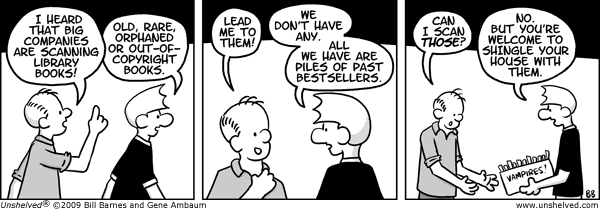
Unshelved comic for 9/9/2009 www.unshelved.com

One of the rallying cries of people who want copyright reform and pirates alike is "Information wants to be free!". One of the wonderful things about libraries is that information is (mostly) free - although there is still an impressive amount of copyright violation going on in public libraries.

First, it's important to note that the main idea of librarianship is legal. The American Library Association (ALA) states that under the "first sale" doctorine, the lending out copyrighted materials is protected by law. Any materials that are no longer protected by copyright (such as Hamlet, but not a Translation of The Inferno, because the translation is still copywrited) or published under a Creative Commons license doens't have those concerns.


However, books aren't the main pirated material in the library. Unsuprisingly, that would be music. As an employee of the Fargo Public Library, I have seen people come in, rip our CDs without checking them out, and then put them back on the shelves.

This is definately not a strictly a Fargo phenomenon. In a blog entry from The Library Journal, which references a since-removed Chicago Tribune article and poll, finds that this is widespread among the patrons from Chicago's public Library system.  The article points out that although it is copyright violation, most of the people who responded to the poll believed it fell under fair use. Borrowing a CD and ripping it, or taping a song of the radio are similarly illegal, but all of these methods are looked over, since it isn't the major music lables don't see that as a major threat to sales.


Another form of copyright infringement that happens frequently is the use of photocopiers in the library.  Most libraries (both public and academic) provide photocopiers to their patrons, and for 10 cents, any item may be copied . Most often, at least at the Fargo Public Library, it's specific articles from newspapers being copied. This is generally looked over by the copyright holders (The Fargo Forum, in this case) because it is such a small scale copyright infringement.

All of these copyright violations aren't attacted, possibly because the Internet is not involved. Any attempt at internet copyright infringement - downloading or viewing anything illegal on a library computer or wireless network- is strictly forbidden by the libraries policies, and doing that would get you banned from using the computers. 

It's interesting to see how libraries can be seen as a haven of copyright infringement, and how libraries can and do avoid that label, and continue to provide free information for their patrons.

Friday, February 11, 2011

The Economic Impact


Libraries provide a number of important services for free. This infographic demonstrates how helpful libraries are to the public, and how often their services are used.

However, libraries are not cheap to run. Due to the current economic conditions, there has been talk of closing libraries to help cities. Fortunatley, there have been few library closings.

One of the most notable was the Philadelphia Free Library system, which was very close to closing, but fortunately, the Pennsylvania state legislature voted to keep the library open. Although it's quite possible that the politicians in the Pennsylvania state legislature where convinced they could keep the libraries open, the article says that they received over 2,000 letters in support of the library. I don't know if being prominantly featured on Boing Boing helped produce some of those letters, but I doubt that the national attention hurt the cause of the library.

One of the reasons that I bring up the importance, and reality, of library closing is that The Camden, NJ library closed today. It's interesting to see the similarities between the articles about the Philadelphia free library system, and what's happened in Camden.

According to the article, Camden had a similar political situation, where the city closed the library's branches, and focused on running only one library. However, the city found it completely infeasible, based on the article, to continue the library service

The (admittedly brief)  article also states that Camden is "one of the nation's most impovershed cities. Most of it's families don't own computers." The statement about computer ownership being a basic part of wealth is interesting, and reminds me of a NPR story about Broadband adoption and Latinos. The Story Begins with a crowded public library, which has every computer in use. The story focuses on the comparatively low adoption of high-speed internet by Latinos, but the beginning shows how important libraries are to providing the service.

It's a paradox - the city arguably needs the library for the resources it contains, because of the poverty that is arguably characteristic of the city. Yet, the city cannot support a library that provides those resources to the people, and help those people in the long run. It is also worth noting that Camden's school system is controlled by the state of New Jersey, and that the city has severe problems with corruption, crime, and low graduation rates, on top of the poverty. 

Friday, January 28, 2011

The advent of audiobooks.

The First Chapter of Sir Arthur Conan Doyle's The Hound of the Baskerviles (A Sherlock Holmes Novel) in a Public Domain Audiobook file

Audiobooks have been staples of public libraries for quite some time.  Initially (at least at the Fargo Public Library) most audiobooks where in a special tape format for people who are visually disabled.  However, audiobooks in popular format (initially cassette tape, then CD) where eventually offered.

This was great for patrons who do not necessarly have a visual imparement, and want to listen to an audiobook. Audiobooks in physical format are often prohibitivly expensive, often due to the sheer number of disks or tapes that are required to contain the whole book. For example, an unabridged recording of James Joyce's Ulysses costs 56 dollars on Amazon, and is spread over 40 disks.

Although cost isn't as big of a problem for libraries, the number of disks is. If a patron where to loose one disk, or a disk was to be scratched beyond repair, the whole audiobook can't be circulated - you can't replace individual disks on audiobooks.

Recently, audiobooks have been offered digitially, both for sale (for example, Audible.com has a subscription program that gives you 1 book a month for 15, significantly cheaper than buying one physical audiobook), for free if they are in the public domain (Librivox) and to check out from a library.

Both the Fargo Public Library and The Lake Agassiz Regional Library System (Moorhead Library) have started offering audiobooks to check out. The advantages to this for the library patron is that they have access to audiobooks, without having to worry about the problems inherent with physical media. However, the patron has to be able to support the system - having a computer and/or an MP3 player, which not everybody has. Also, like any other library item, a patron must "return" their audiobook - meaning that it comes with DRM (Digital Rights Management - code that restricts your ability to use the software) that will delete the files by a certain date.  Most advanced computer users despise DRM, however, it is a necessity for the free audiobooks. 

It is interesting to see how audiobook technology has changed, and how libraries have adapted historically, and how they are continuing to try to provide for their patrons.  Circulating digital materials is a new innovation for the libraries, and one that can be seen as going against the traditional role of libraries. It can also be seen as libraries living up to their potential, providing new services to get information out to the people. 

Friday, January 21, 2011

Technology and Libraries Overview!

Unshelved comic - January 12, 2011. www.Unshelved.com
Technology has always been a prominent part of librarianship. In fact, libraries where one of the first users of the internet, accessing digitalized catalogs from other libraries at least a decade before internet usage became widespread. New innovations are always being considered by libraries - for example, the Fargo Public Library has began to offer Ebooks for patrons to download, as well as free internet access, computer classes, and resources to learn about new tech.

This is a great thing for making technology accessible.  As we have stated in class, socio-economic class plays a big part in the adoption of technology, and those who aren't as fortunate as others are often left in the proverbial dust. However, the fact that anybody can use the computers at a Public library is a great equalizer, and at least lessens the divide between those who are technologically literate and those who are not.

However, the current system is far from perfect. First and foermost, libraries have limited funds to purchase technology,and also must balance their budget to pay for their employees, new physical materials (books, movies, etc.) and building maintainance.

This limits the amount of computers a library can have, which means that only a few patrons can be fully utilizing a library's technology at any time.  Also, the computers are one of the most used things in the library, it can be hard to gain access during any time of the day.

 Also, school libraries, where technology would be the most beneficial, are having the hardest time affording everything.  According to this article form the School Library Journal

      "After seeing so many schools redirect their library dollars to technology and audiovisual equipment, Knickerbocker created the Snapdragon Book Foundation, which helps foster children's literacy by providing financial grants to media centers that serve disadvantaged youth... Our ultimate goal is to do what we can to see that school libraries are still offering children good books to read—and to help the ones most in need"

Finally, many people have very fixed views of what a library is, how it looks, and it's functions in the current society. These people often reject the ideas of the increased focus of technology in the library, and are concerned with the how prominent it is currently.  This article from the Martha's Vinyard Times demonstrates this perfectly. The author quotes a current librarian:

"Libraries are trying to imagine their futures with or without books," Mr. Sutter continued. "Books are being pushed aside for digital learning centers and gaming areas. 'Loud rooms' that promote public discourse and group projects are taking over the bookish quiet. Hipster staffers who blog, chat on Twitter, and care little about the Dewey Decimal System are edging out old-school librarians."

And follows up with a single word reaction:

"Yikes."

Libraries, especially public libraries, need all the support that they can get. And having people who do not necessarily understand technology or how libraries are planning for the future are a hinderance for everybody.


Technology plays an incredibly important part in modern librarianship, and will continue to change both with and for libraries.